


When the first wave of enterprise AI arrived, executives focused on one metric: productivity. The promise sounded irresistible. Employees would generate reports faster, write code faster, analyze data faster, and complete routine tasks in a fraction of the time. AI would eliminate drudgery and free knowledge workers to focus on higher-value activities.
Then something unexpected happened. Organizations discovered that while employees were working faster, they weren’t necessarily producing more business value. A new role quietly emerged inside companies. The Botsitter.
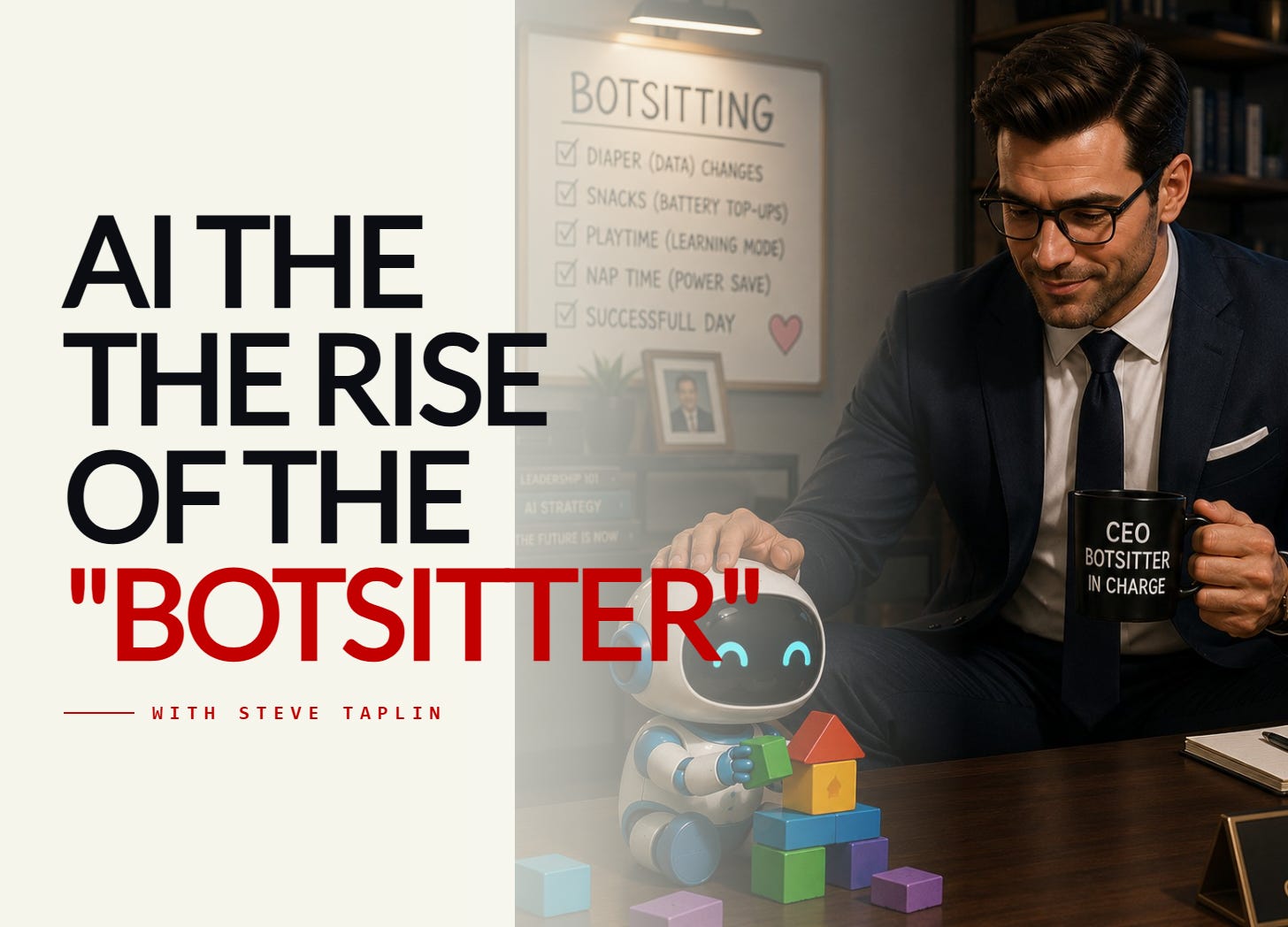
This isn’t a formal job title. It’s the employee who spends part of everyday supervising AI systems, checking their work, correcting mistakes, supplying missing context, validating outputs, and rewriting content that looked impressive but wasn’t entirely accurate.
Right now, the hidden cost of AI isn’t the technology itself. It’s the growing number of people required to manage it.
This issue became visible in June 2026 when Glean’s Work AI Institute, working with researchers from Stanford, UC Berkeley, Notre Dame, and other institutions, released findings from a survey of 6,000 digital workers across the United States, United Kingdom, and Australia. The researchers found that employees spend an average of 6.4 hours every week “botsitting” AI systems. That time includes feeding AI context, reviewing outputs, correcting errors, debugging results, and validating information.
Think about that for a moment. A typical employee is spending almost an entire workday each week managing AI. That’s not what most executives expected when they approved their AI initiatives. What’s even more revealing is the gap between individual productivity and organizational performance.
Measuring the Wrong Thing
An employee may generate twice as many reports with AI assistance. A developer may produce more code. A marketing team may create more content. Yet if the organization spends substantial time reviewing, correcting, and validating those outputs, the expected gains begin to evaporate.
The result is what researchers are increasingly calling the AI Productivity Paradox. Workers feel faster. Companies don’t necessarily perform better.
At Sonatafy, we’ve seen a version of this problem before.
Years ago, organizations adopted email, collaboration tools, project management systems, and video conferencing platforms with the expectation that communication would become more efficient. Instead, too many employees started to become coordinators of technology rather than producers of value. The tools created new work. AI appears to be following a similar path.
Research from Workday found that nearly 40% of the time employees save using AI is lost to rework. Workers spend that time correcting errors, rewriting content, validating outputs, and fixing low-quality results. According to the study, for every ten hours of productivity gained through AI, nearly four hours are lost cleaning up its work.
The challenge becomes even greater in software development. AI coding assistants can produce thousands of lines of code in minutes. Productivity dashboards show impressive activity levels. Yet code is not value. Working software is value.
Developers increasingly find themselves reviewing AI-generated code, testing outputs, fixing edge cases, validating security concerns, and correcting architectural decisions that AI lacks sufficient context to understand.
The developer becomes a supervisor
The AI becomes a junior employee that never stops producing work
The volume increases dramatically
The oversight burden increases as well
This creates a dangerous illusion for executives
When leaders see more code, more reports, more presentations, and more content being generated, they naturally assume productivity is rising. What they’re witnessing the rapid production of work that still requires human review before it can create business value.
AI is moving labor rather than eliminating it
Tasks that once required creation now require supervision
Tasks that once required writing now require editing
Tasks that once required research now require verification
The work hasn’t disappeared
It’s simply changed form
This doesn’t mean organizations should slow their AI adoption. Far from it. When you’re calculating AI return on investment, leaders should measure more than time saved. You also need to measure:
Time spent validating AI outputs
Time spent correcting errors
Time spent supplying context
Time spent switching between tools
Time spent reworking AI-generated content
Time required to train employees to use AI effectively
Those costs belong in every ROI calculation. Organizations that ignore them risk overstating the benefits and understating the operational burden.
