


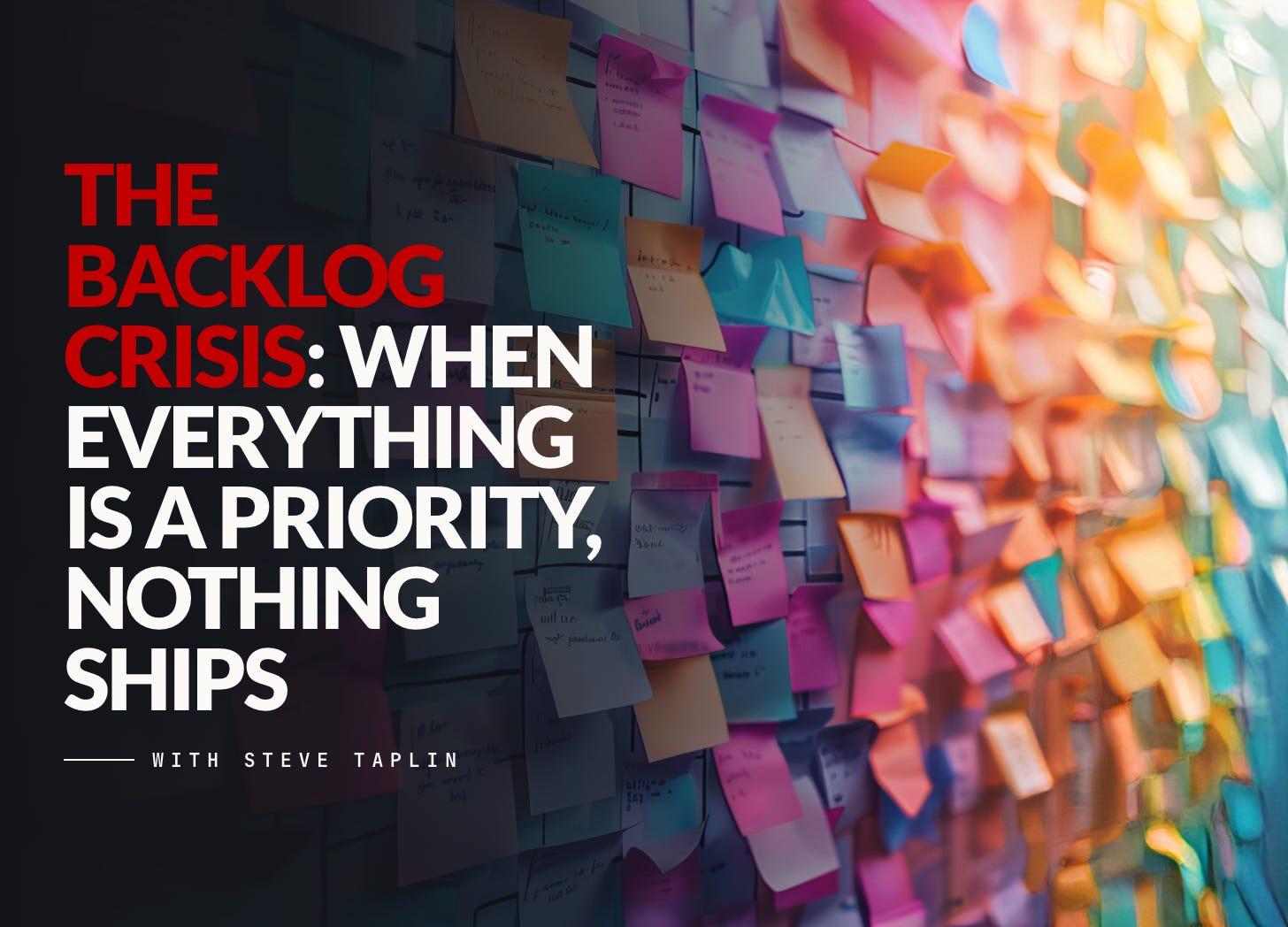
Most software organizations don’t fail because their teams lack talent. They fail because they refuse to make a choice. Work continues to enter the system faster than leadership is willing to constrain it. Over time, the backlog becomes less a plan and more a record of unresolved priorities.
Every request arrives with a rationale. Revenue depends on it. Compliance requires it. A customer is waiting. A competitor just shipped something similar. Each justification stands on its own. Taken together, they create an environment where saying no feels riskier than saying yes.
So, management avoids making a decision, and the backlog continues to grow.
VISIT MY SUBSTACK FOR FREE ARTICLES, VIDEOS & PODCASTS >
Priority inflation doesn’t happen all at once. It creeps in gradually as exceptions accumulate. A feature gets expedited to support a deal. Another is elevated to address regulatory concerns. A third is labeled urgent because it supports a marketing initiative.
Soon, prioritization loses meaning. High priority becomes the default rather than the exception. Teams are told everything matters, which is another way of saying nothing has actually been decided.
From the outside, everything still looks functional. Roadmaps exist, meetings happen, Jira boards stay active. But inside the system, it’s all deteriorating.
The Backlog as a Way to Avoid Conflict
When leadership won’t resolve tradeoffs, the backlog becomes a holding area for disagreement. Competing demands sit side-by-side without reconciliation. Items are ranked, re-ranked, and re-labeled, but never truly resolved.
Product managers feel this immediately. Roadmaps stop functioning as commitments and start functioning as suggestions. Engineers stop trusting the timelines because priorities continue to shift mid-sprint. Planning becomes a political process instead a prelude to delivery.
Everyone is busy, but the output continues to decline.
Why the Backlog Isn’t a Product Management Failure
Too many companies treat prioritization as a product problem. They expect product managers to sort through competing initiatives and solve the problem through better planning.
Yes, product managers can organize information. They can estimate effort. They can even surface tradeoffs. What they can’t do is resolve executive-level conflict about what the business is willing to delay or sacrifice. That responsibility sits higher in the organization, whether it’s acknowledged or not.
The Illusion of Progress
One of the most dangerous moments in a backlog crisis is when activity remains high. and everything seems to be moving forward.
It all looks good, but what’s really happening is that your engineers are spending more time reorienting to new priorities than completing the work.
By the time leadership notices, the ability to get anything done has already eroded.
Why Frameworks Don’t Solve Priority Failure
This is typically the point where companies introduce new prioritization frameworks designed to rationalize decision-making.
While it’s true that some structure helps create visibility, none of it substitutes for leadership judgment.
Frameworks don’t remove politics. All they do is formalize indecision.
And the backlog continues to grow, just with better documentation.
The Cost of Constant Reprioritization
Every mid-stream priority change carries an execution tax.
These costs rarely appear in reports, but they compound quickly. Over time, teams become frustrated and stop committing, as deadlines become aspirational rather than real.
People don’t disengage because they don’t care. They disengage because the system has taught them that priorities don’t matter.
What Real Priority Requires
Real prioritization shows up as initiatives that are explicitly delayed, requests that don’t make the cut, and features that are put to the side, even when their business case is strong.
This kind of decision-making is uncomfortable. It forces leadership to disappoint someone in the short term so that they can preserve execution in the long term. The problem is that too many organizations avoid that discomfort until the cost becomes unavoidable.
The Responsibility That Can’t Be Delegated
If everything is labeled a priority, that isn’t a team failure. It’s a failure of leadership. It means the organization hasn’t decided on what really matters.
Teams need clarity. But only management can create it.
When nothing ships, the problem isn’t effort. It’s decision avoidance. And no amount of process improvement fixes a system that refuses to choose.
That’s why responsibility never belongs in the backlog. It belongs with leadership.
