


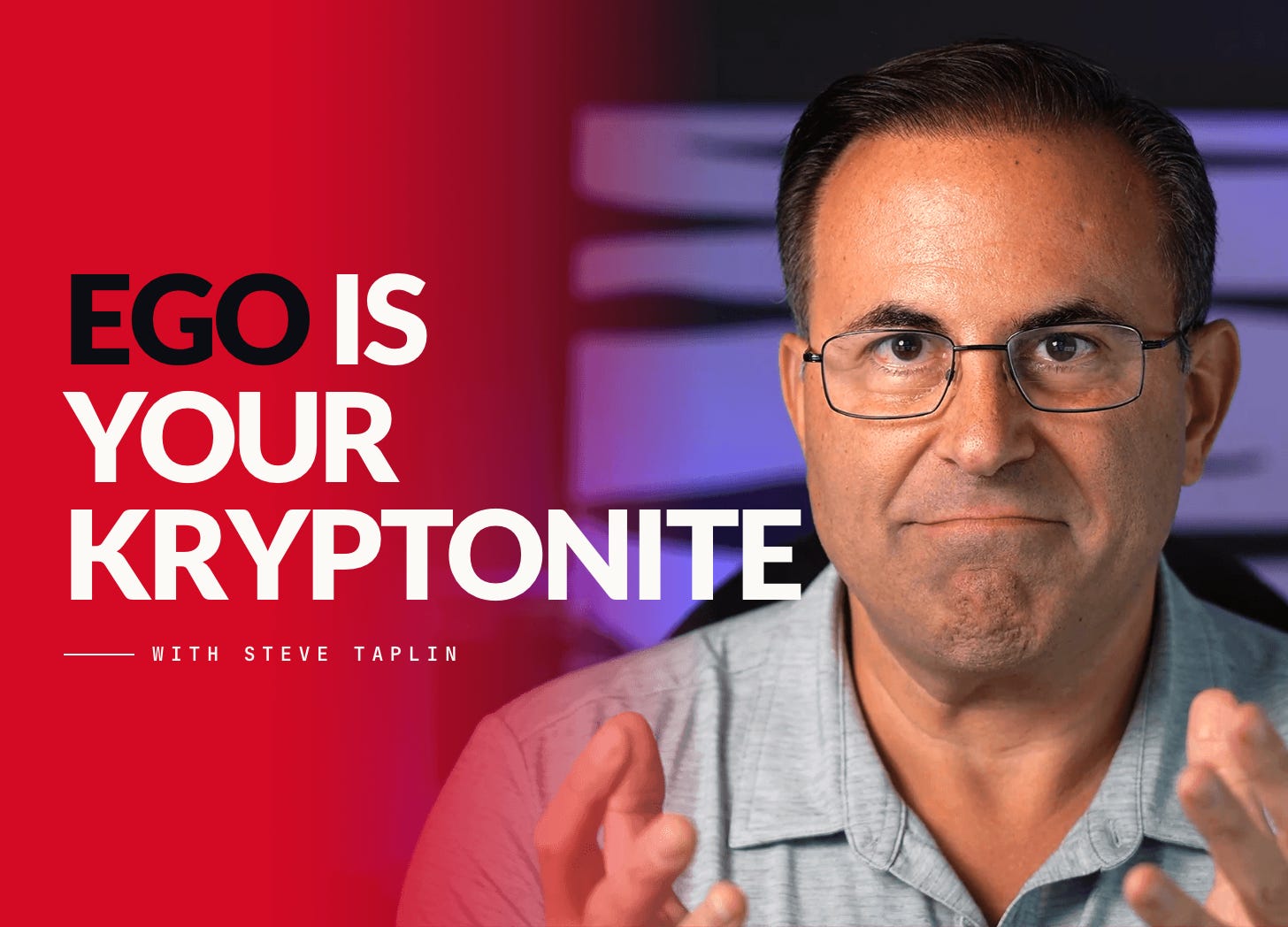
Superman understood that kryptonite was the one thing that could bring him down. For entrepreneurs that one thing is ego.
Ego is what turns a lesson into a wound. It’s the voice in your head that says, “You can’t admit this went wrong,” or “If you fail, you’ll look weak.” It’s what makes you double down on a bad decision just to avoid saying, “I was wrong.” Ego transforms failure from a stepping stone into a dead end.
VISIT MY SUBSTACK HOMEPAGE FOR MORE FREE ARTICLES >
I remember when my first venture tanked. I couldn’t believe it. In my mind, I’d done everything right – from researching the market, to understanding the customer, to building a product that was fail proof. But fail it did and when that happened I started looking for scapegoats. Instead, I should have looked in the mirror.
When your ego runs the show, you stop listening. You stop learning. You start blaming. You either ignore feedback or surround yourself with people too afraid to give it to you. And just like that, your greatest advantage—your ability to adapt, evolve, and grow—disappears.
Failure works only if you’re willing to look at it honestly. If you can’t take ownership, can’t be vulnerable, can’t ask, “What can I learn from this?”—then failure loses its magic. It becomes something you fear, something you hide from, and ultimately, something that breaks you.
Entrepreneurs who let ego override insight become rigid. They build echo chambers instead of resilient companies. They burn out and implode.
Stay Hungry. But Stay Humble.
Whenever you fail, try and remember that you’re not alone. Today, their names are iconic, but before they hit it big, famous people in every field faced repeated setbacks before achieving success.
Humphrey Bogart spent more than a decade as a supporting actor before becoming a star.
F. Scott Fitzgerald, the author of The Great Gatsby, received 122 rejection slips before he sold his first short story.
Sir James Dyson built 5,126 failed prototypes over 15 years before perfecting his revolutionary vacuum cleaner.
Walt Disney was once dismissed by a newspaper editor for lacking imagination and faced multiple business failures before creating the iconic Disney brand.
Before turning Starbucks into a global brand, Howard Schultz faced rejection from more than 200 investors when trying to raise money to buy and expand the company.
At the age of 65, Harland Sanders had nothing but a secret fried chicken recipe and a beat-up car. After being rejected by hundreds of restaurants, he finally convinced one to take a chance. That single deal turned into the KFC empire.
Tom Brady was the seventh-string quarterback when he joined the University of Michigan. When the 2000 NFL Draft came around, 198 players were picked before him. Yet he persevered and went on to win 7 Super Bowl titles, earn 3 MVP awards, and become widely considered the greatest quarterback in NFL history.
Failure only becomes useful when you reflect. Without reflection, you’re just stacking regrets. With reflection, you’re collecting data. Why didn’t that product work? Was the market wrong—or was your messaging off? Did you miss a signal? Did you move too fast, or too slow? These aren’t rhetorical questions—they’re the beginning of a smarter strategy. Every failure is a map pointing you in a better direction. If you’re brave enough to read it, you’ll never be lost for long.
Entrepreneurs who thrive build their businesses around this feedback loop. Try something. Watch it break. Study the break. Rebuild better. Repeat. This cycle isn’t glamorous. It’s gritty. It’s emotional. But it works. It’s how the best companies are built, and how the most resilient leaders are forged.
Resilience is the Hidden Currency of Entrepreneurship
When you’ve had a deal fall apart hours before signing, when you’ve laid off a team you loved, when you’ve run out of cash and still showed up the next day—that’s when you become unbreakable. That’s when failure stops being something to avoid and starts being something you trust. Because you’ve seen what it gives you. Clarity. Grit. Growth.
Failure also strips away ego. It teaches you that you don’t know everything—and that’s a gift. Because when you stop pretending to be perfect, you start attracting the right people. You become a better leader, a better listener, and a better builder. Investors trust you more. Teams rally behind you more. Because people follow leaders who’ve been tested—and passed.
There’s also a practical side to all this. Failure builds pattern recognition. Once you’ve been burned by a bad hire, you get sharper at spotting red flags. Once you’ve wasted money on a bloated marketing strategy, you learn to cut faster and spend smarter. Every mistake adds a layer to your instincts. Over time, those instincts become your edge.
But here’s the secret most people miss: to make failure your superpower, you have to keep going. That’s the part that separates the ones who make it from the ones who don’t. You can’t just reflect—you have to act. You have to rebuild with what you’ve learned. You have to step back into the arena with the scars still fresh and swing harder. That’s what makes failure powerful. Not the fall—but the comeback.
If you want to build something that lasts, something meaningful, something that matters—you will fail. Over and over. But if you’re willing to treat failure as a mentor, not a monster, you’ll become sharper, faster, more creative, and more courageous than you ever imagined.
So don’t hide your failures. Use them. Talk about them. Learn from them. Build with them. Every great entrepreneur has a graveyard of failed ideas behind them. It’s not a shameful secret. It’s the price of mastery.
In the end, failure is only failure if you stop learning. If you choose to keep growing, to keep iterating, to keep going—failure becomes the thing that sets you apart. It becomes your advantage. Your fire. Your superpower.

Love the storyline here Steve. I have first hand seen ego get in the way of many leaders success. But it's important to differentiate between strong healthy ego and unhealthy blinding ego. Why? Because without strong healthy ego, entrepreneurs don't persevere through business and life challenges. Failure leads to giving up. Believing in oneself is associated with a strong healthy ego. Without that unshakable belief, we often throw in the towel at the first wrong turn.
Here's the AI summary of the relationship between ego and perseverance:
Ego and perseverance have a complex, dual relationship: a healthy, resilient ego (ego-strength) fuels perseverance by building confidence and adaptability, while a fragile or inflated ego hinders it through fear, arrogance, or ego depletion, leading to quitting or self-sabotage, but paradoxically, ego depletion can also trigger energy conservation, reducing persistence. True perseverance thrives not on ego's need to be right, but on humility, self-awareness, and a commitment to growth, allowing one to adapt, learn from failure, and keep going despite setbacks.